From Data Chaos to Clarity: AI Solutions Every Modern Enterprise Needs
Imagine trying to sort through one trillion songs on your computer. It’s a mind-boggling number to try and wrap your head around (especially considering only around 100 to 200 million songs have ever been recorded). Now imagine trying to organize them all.
That’s the state of enterprise data for the vast majority of companies. The majority of business data today is unstructured. It’s buried in documents, emails, PDFs, and files that don’t follow consistent rules. That’s where the problem starts.
Files get misplaced. Teams work from different versions. Sensitive information ends up in the wrong place. Employees spend hours every week searching for what they need instead of acting on it. Over time, this leads to data chaos.
Artificial Intelligence (AI) document management offers a way out of that cycle. Instead of relying on manual processes and rigid systems, it introduces intelligence into how documents are captured, organized, and used.
In this guide, we’ll break down the AI solutions transforming how enterprises manage documents that reduce stress, disorganization, and wasted employee hours.
What Is AI Document Management?
AI document management is an approach to managing enterprise information that uses artificial intelligence to organize, understand, and automate how documents move through your business.
At a basic level, a traditional document management system helps store and retrieve files. But it relies heavily on manual input. Employees still have to tag documents, place them in folders, set rules for how they’re handled, and manage these rule-based workflows.
AI changes that by making document management automatic. Documents are analyzed as they enter the system. Key information is extracted. Files are categorized and tagged without manual effort.
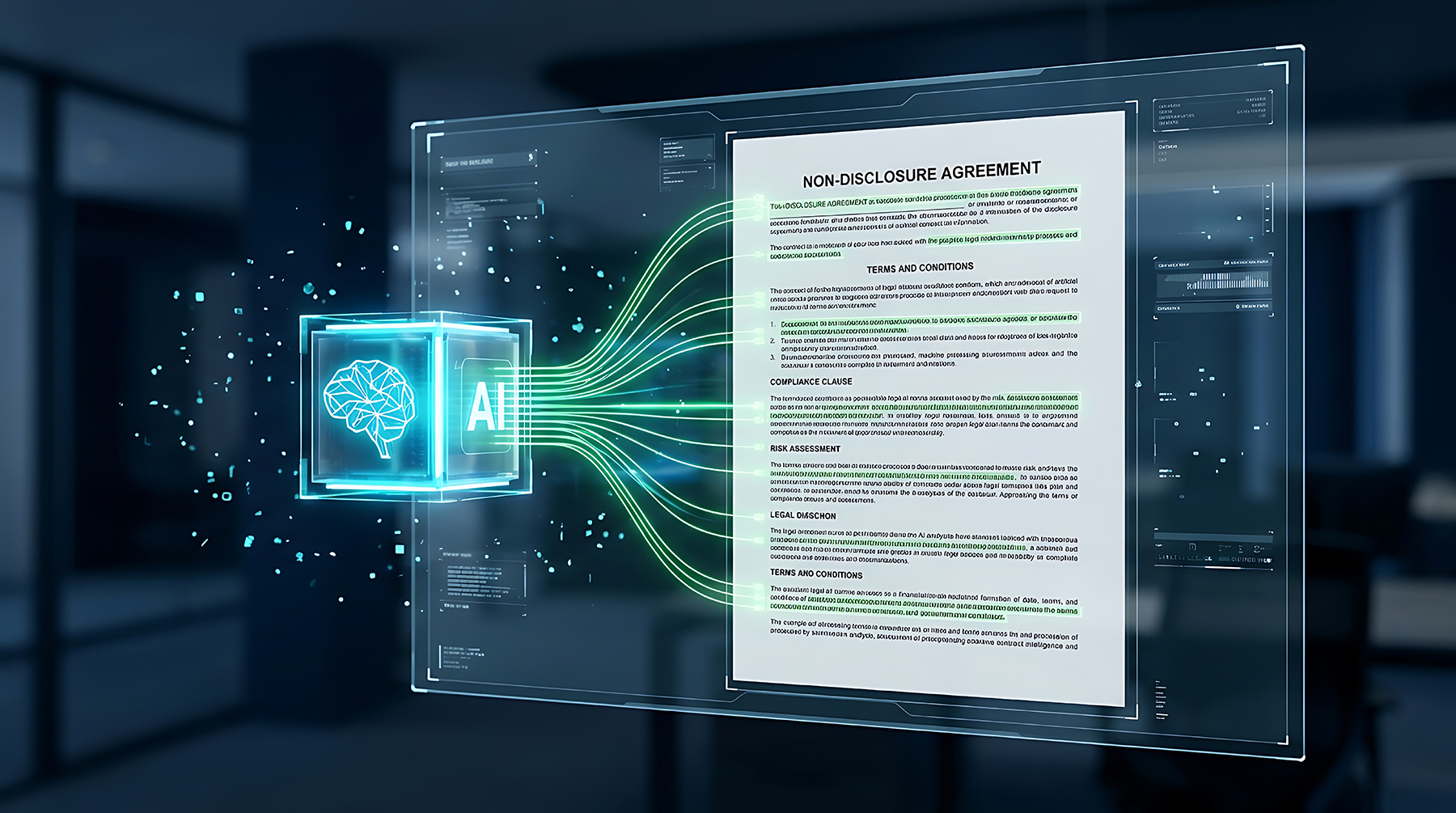
Intelligent document processing combines technologies like optical character recognition (OCR) and machine learning to read documents, understand their content, and act based on what it finds. From there, employees can use intelligent search and retrieval to find the documents they need quickly and easily.
For enterprises, AI document management means less time managing files and more time using them.
The Real Cost of Document Chaos in Enterprises
Most organizations don’t notice document chaos all at once. It builds gradually. A file gets saved in the wrong place. A version gets duplicated. A process that used to take minutes starts taking hours. Over time, these small inefficiencies result in employees spending an average of one day out of every work week searching for information to do their jobs effectively.
That cost can be compounded if the employee can’t find what they are looking for. Once these issues become systemic, the cost of compliance failures is often double the cost of maintaining compliance.
The document chaos causes three main pain points for businesses.
Operational inefficiency
Manual filing, duplicate documents, and inconsistent naming conventions slow everything down. Work gets repeated. Processes take longer than they should.
Security and compliance risk
When documents aren’t controlled properly, sensitive information can be exposed. Missing audit trails and inconsistent governance increase the risk of compliance failures. It also puts businesses at risk for compliance violations for regulations such as General Data Protection Regulation (GDPR) and Health Insurance Portability and Accountability Act (HIPAA).
Collaboration breakdown
Teams can’t move quickly if they’re not working from the same information. When documents are siloed or hard to access, approvals slow down and decisions take longer.
These three pain points highlight the gap AI document management is designed to close. The organizations that address it early are the ones that create clearer access to information, stronger control over sensitive data, and faster, more reliable ways of working.
Core AI Solutions Every Enterprise Needs
At its core, AI document management is a set of capabilities that work together to remove friction from how information flows through your organization. Here are the core components that make the biggest impact:
1. Intelligent Document Capture & Data Extraction
Traditional document capture stops at scanning. AI goes further.
When a document enters the system AI can read it, extract key data, and validate that information automatically. It doesn’t matter if it’s a PDF, image, form, or another type of document because it doesn’t just capture text. AI also understands structure and context.
AI document management tools save employees time, reduce manual data entry errors, and result in faster processing times for tasks like invoicing, contracts, onboarding forms, and compliance documentation.
For example, an invoice can be processed without manual data entry. Key fields like vendor name, amount, and due date are identified and routed to the right system.
2. Automated Classification & Smart Tagging
Organizing documents manually doesn’t scale. As volume grows, consistency drops.
AI solves this by classifying documents automatically. It recognizes patterns based on content, structure, and past behavior. Over time, it learns how your organization handles different types of documents and improves its accuracy.
Instead of relying on employees to tag files correctly, the system applies consistent metadata across everything. No human input needed.
This creates a more organized, searchable environment without adding extra work.
3. Natural Language Search & Retrieval
It’s unrealistic to assume employees will remember where every business file is stored. With natural language search and retrieval, all employees have to do is ask the AI document management system what they need using plain language. No navigating folders or guessing keywords. The system understands intent and context, not just exact matches.
That means someone can search for “latest signed vendor contract” and get the right result immediately — even if the file name doesn’t match those exact words.
The result is simple: finding a document takes seconds, not minutes.
4. AI-Driven Workflow Automation
As documents move through approvals, reviews, and compliance checks, AI can automate those workflows based on the content of the document itself.
For example:
- Contracts can be routed for legal review automatically
- Invoices can be sent for approval based on amount thresholds
- Forms can trigger onboarding workflows
Instead of relying on manual handoffs, AI-driven workflow automation keeps processes moving. This reduces bottlenecks and shortens cycle times across the business.
5. Compliance & Security Automation
Managing risk manually is difficult, especially as data volume grows.
AI can identify sensitive information within documents (such as personal data, financial details, or confidential clauses) and apply the appropriate controls automatically.
It can also:
- Enforce retention policies
- Track access and changes
- Maintain audit trails
- Ensure compliance with GDPR, HIPAA, System and Organization Controls (SOC 2), and other regulations automatically
With compliance and security automation, security becomes part of the system, not an afterthought.
6. Intelligent Version Control & Collaboration
Say goodbye to file names like “final_final_v4” and questions of “which version of the document are you working from?”
AI helps track changes, identify conflicts, and surface the most relevant version of a document. It can flag outdated files and reduce duplication. This AI document management tool can also be integrated with Microsoft 365, Google Workspace, Slack, and other enterprise collaboration tools. Teams can then work within their existing workflows while staying aligned with the same information.
Industry-Specific Applications
AI document management shares the same goals through all industries: reduce manual work and improve access to information. However, its impact shows up across different parts of the business. Here’s a few industry specific applications:
- Legal: Contract lifecycle management, e-discovery, clause extraction
- Finance & Accounting: Invoice processing, audit prep, financial report management
- Healthcare: Patient records, HIPAA compliance, claims documentation
- HR: Employee onboarding, policy management, employee file organization
- Manufacturing/Supply Chain: Vendor contracts, compliance certifications, technical documentation
How to Choose the Right AI Document Management Solution
Not all AI document management platforms are built the same. Choosing the right one comes down to how well it fits your organization’s needs. Here are the key factors to evaluate:
Integration capability
The system should connect with your existing tools without adding complexity. Don’t change the tools you are using. Instead, expect an AI document management system that is capable of working alongside your enterprise resource planning (ERP), customer relationship management (CRM), and cloud storage software.
Scalability
An AI document management system should do more than handle your current volume. It needs to grow with you. What works today should still work five years from now.
Security standards
Look for strong security practices, including end-to-end encryption and recognized certifications such as SOC 2 and ISO 27001.
Ease of adoption
If the AI document management system you are considering purchasing is difficult to use, teams won’t adopt it. Simplicity matters. There shouldn’t be a steep learning curve for your non-technical teams to get up to speed.
AI transparency
The system should provide visibility into how decisions are made, especially when classifying or flagging documents.
Vendor support and direction
Technology evolves quickly. The AI document management system provider should be actively improving the platform and investing in future capabilities. Find a provider where the goal isn’t just to solve today’s problems. Your AI document management system should adapt and grow as your needs change.
What to Expect After Implementation
AI document management doesn’t fix everything overnight, but improvements tend to show up quickly. Right out of the gate, organizations typically see:
- Faster document retrieval
- Fewer compliance issues
- Reduced manual work
- Improved employee productivity and satisfaction
- More efficient processes (contract signing, invoice processing, onboarding, etc)
Over time, the system becomes more effective as it learns from your data and workflows. Keep in mind that AI document management isn’t a one-time upgrade. It’s an ongoing improvement in how your organization handles information.
Document chaos usually comes from systems that were never designed to scale with modern data demands. AI document management changes that.
It’s a shift from reactive, manual processes to systems that organize, protect, and move information automatically. The result is better visibility, faster decisions, and fewer operational barriers.
As data continues to grow, the gap between organizations that manage document management well and those that don’t will only widen.
Don’t wait. See how AI document management works in practice. Schedule a Sys.tm® demo and explore what it could look like for your organization. AI document management is the answer your enterprise needs to spend less time managing information and more time using it.