Processes Every Business Should Automate This Year
Automation is no longer a competitive advantage—it’s a baseline expectation.

By 2026, businesses that still rely heavily on manual processes will struggle with speed and scalability.[1] The challenge is not whether to automate, but what to prioritize first and how to do it intelligently. Below, we explain the technology building blocks of automation as well as reviewing core business processes that organizations should evaluate for automation this year. Each process is accompanied by practical questions to help get you started. We’ll also explain how technologies like our own Sys.tm® can create significant financial return by supporting automation initiatives.
Building Blocks of Automation

Before diving in, it’s helpful to understand the three technologies or building blocks of modern automation:
- Intelligent Document Processing (IDP) focuses on extracting and structuring information from documents, such as invoices, forms, and records, so it can be used directly in business workflows.
- Workflow is used to move information through a predictable series of steps.
- Robotic Process Automation (RPA) automates repetitive, rules-based tasks such as moving data between systems or updating records by mimicking human actions.
Together, these three technologies can automate core business functions to speed business, improve decision-making, and even boost employee morale.
Bonus Building Block: Composable Technology
Sys.tm, developed by Digitech Systems, brings these capabilities together in a single platform, unifying information management and business automation in a cloud-based environment. Built on a microservices architecture, Sys.tm is unique in that it allows companies to adapt which product capabilities they need at any given time or for a given process. Best of all, Sys.tm only bills for what a client actually uses, and many features are billed based on usage. This composable product streamlines access to critical business technologies but right-sizes costs and capabilities to suit different needs and company sizes.[2]
6 Processes that Should Be Automated
Across the enterprise, companies are finding clever ways to automate that improve process efficiencies, save the organization money, and even grow worker satisfaction. Here are six of the most common processes to automate for rapid results before the end of the year.
1. Document Intake and Data Capture
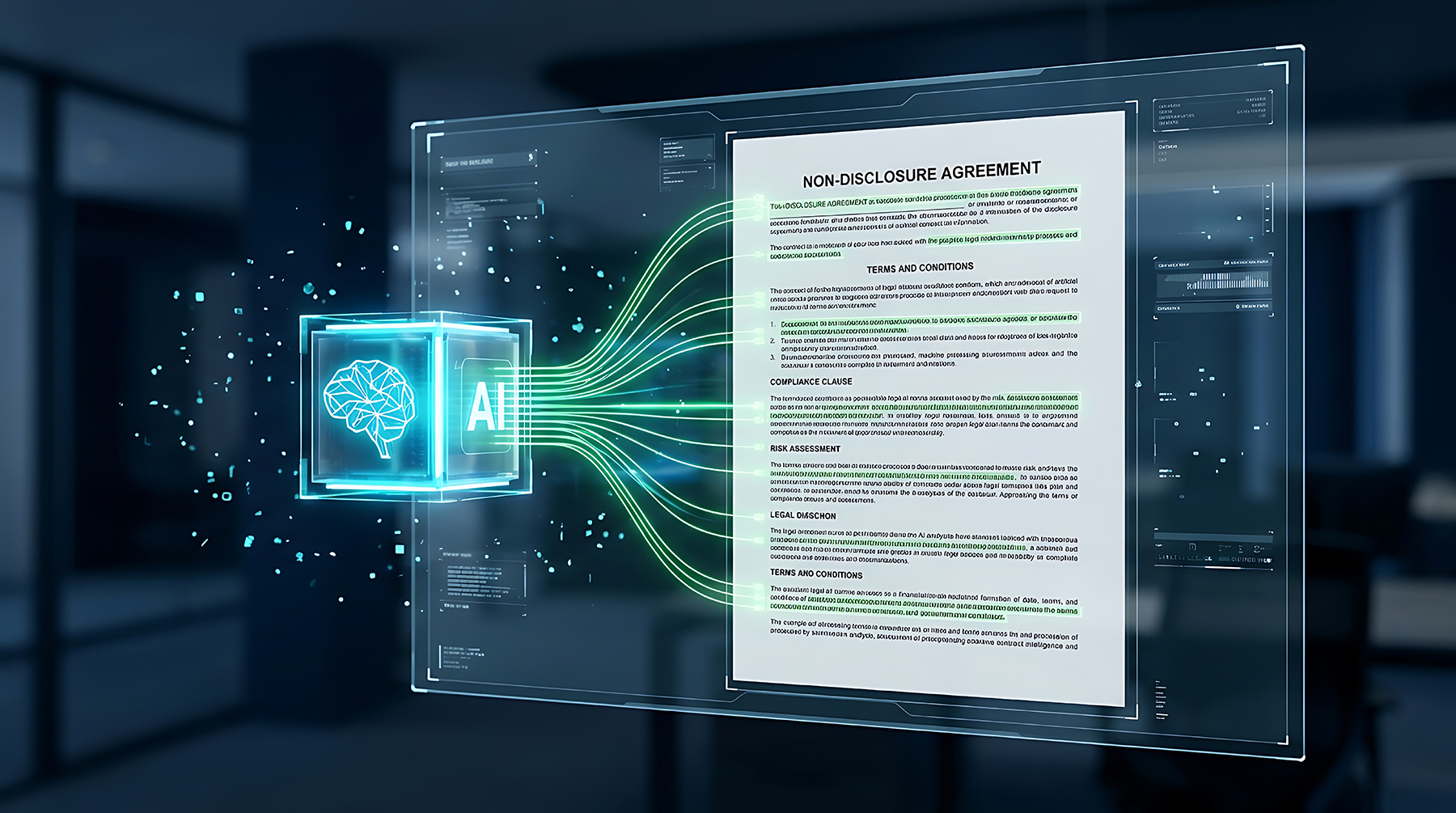
Across operational areas such as healthcare administration, education services, accounts payable, and human resources, organizations rely heavily on incoming documents, including forms, applications, invoices, records, and requests. It is very common for organizations to manually type the critical data from these records into a variety of business applications. However, humans are slow, and we make mistakes, leading to process inefficiencies and rework to correct errors.
Today’s Artificial Intelligence (AI) applications are equipped with tools that can recognize and extract important data from electronic files. Known as Intelligent Document Processing or IDP, these products use AI to scan the text a document contains and to extract key bits of data that can then be used to create the metadata fields, enabling users to search for and find the document later or even to send the information to other line of business applications, eliminating the need for manual data entry. For example, vendor, date, amount, and even line item details can be extracted from invoices and sent to the accounting application, speeding the organization’s ability to quickly process invoices and reducing the risk of error and fraud by replacing human effort with automation.
Questions to Ask
- How is information currently received by your organization (email, paper, online portals or forms)?
- Where do delays occur between document receipt and your company’s ability to access the data? How much time does manual data entry take before information can be used?
- How often are documents misplaced or details incorrectly logged?
How Sys.tm Helps
Electronic documents and scanned copies of paper records can be sent to Sys.tm for IDP processing. Sys.tm® Intelligence, the group of AI capabilities within the information management platform, will recognize certain documents by type and can automatically pull out critical data. The data can be used not only to retrieve the document quickly later, but also to send to any business applications where manual data entry was previously performed using the information the document or file contains.

International Business Products Inc. (IBPI) was formed when a group of companies banded together in 1987 to negotiate better terms through a group purchase of technology. Today, it includes more than 500 member companies, and they have negotiated terms with more than 40 technology vendors. In 2025, they began using Sys.tm® Intelligence to automatically extract data from invoices. Thanks to Sys.tm’s IDP capabilities, they have reduced invoice processing times by 75%, lowering costs and leading to more early payment discounts.3
2. Approval Workflows and Decision Management
Approval processes sit at the center of nearly every business function, from hiring decisions in HR to patient authorizations in healthcare, and administrative signoffs in education. When handled manually through email or paper, they can create delays and inconsistencies.
Today’s workflow products can automatically route documents from person to person, step by step through an automated process that your organization defines. You’re not locked into a standard process configured by software developers, so you can add as many steps or authorizations as needed and even include branches where a document routes differently based on certain criteria or the decision of a specified user. These tools also allow you to track electronic approvals, pause documents while questions are answered, compare information between documents, and even send a record back to a previous step when needed. They make approval workflows and decision management easy and convenient from any location and on any device, so your organization keeps moving.
Questions to Ask
- Where do approval bottlenecks typically occur across your organization?
- Are approval rules ad hoc or standardized for common processes?
- How are approvals tracked and audited today?
How Sys.tm Helps
Sys.tm® Flows, the workflow component of Sys.tm, automates approval workflows by routing requests to the appropriate stakeholders based on predefined rules and tracking every decision in real time. Sys.tm eliminates the need for email-based approvals or manual follow-ups, which can be a source of delays and miscommunication. Beyond basic routing, Sys.tm enables organizations to design structured decision paths that adapt dynamically to business conditions and to embed AI-enabled tasks as process steps. The platform even provides full visibility into approval status across the organization, providing the visibility critical to reduce bottlenecks and keep business flowing. Sys.tm Flows helps organizations standardize decision-making across departments by enforcing consistent rules and ensuring information security.
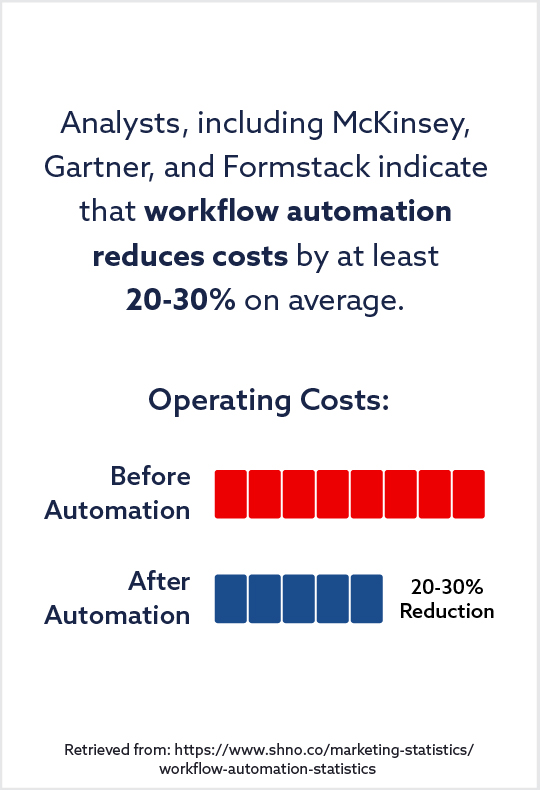
Analysts, including McKinsey, Gartner, and Formstack indicate that workflow automation reduces costs by at least 20-30% on average.[4]
3. Accounts Payable and Invoicing
Accounts Payable (AP) is a frequent target for automation, because they deal with consistent document types (invoices) and the tasks they perform are heavily regulated and rules-based. Manual invoice handling is still common and can lead to delays and limited visibility into financial obligations. In many organizations, invoices arrive through multiple channels and require repeated manual entry across multiple systems. This not only slows down approval cycles but also increases the risk of duplicate payments and compliance issues. As businesses grow, these inefficiencies compound, making it difficult for finance teams to maintain control and accuracy.
Questions to Ask
- How are invoices received, categorized, and processed today? How long does it take (in worker hours)?
- Are invoice approvals and 3-way match processes standardized and in compliance with regulations and security concerns?
- Can invoice status be tracked in real time and approvals processed from any location?
How Sys.tm Helps
Sys.tm can automate invoice processing—saving hours of productivity and ensuring compliance and security. Invoices received in multiple formats and through various means (email, paper, fax, digital, etc.) can be sent to Sys.tm Intelligence for IDP data extraction to eliminate manual data entry. Based on company-defined criteria, Sys.tm Flows then automatically routes the invoice through approvals and compares it to purchase orders and good received receipts before being authorized for payment—presenting each user with corroborating documents and details along the way. Invoices can even be automatically tagged for retention according to company-defined criteria. As an automated process, Sys.tm virtually eliminates opportunities for fraud and mistakes, and it tracks every step of every process for every invoice, giving the organization the information they may need to prove compliance with regulations.
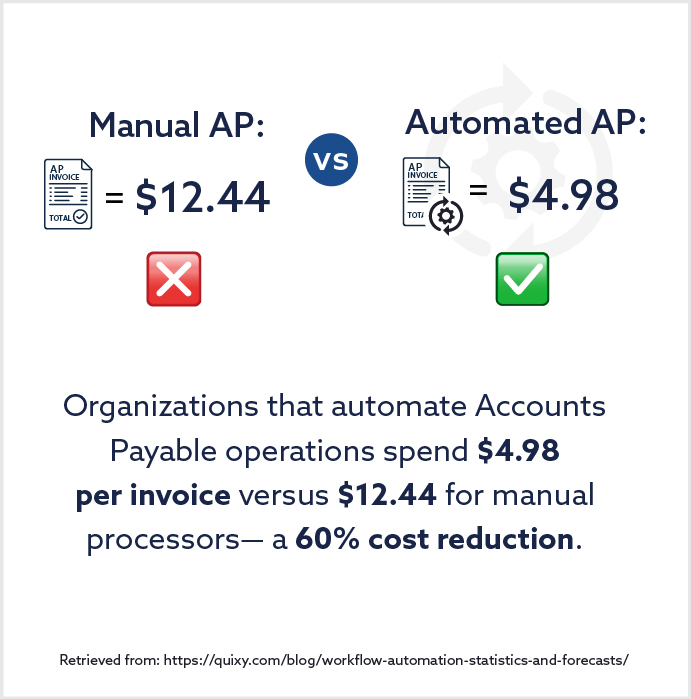
Organizations that automate accounts payable operations spend $4.98 per invoice versus $12.44 for manual processors—a 60% cost reduction.[5]
4. Customer Support and Ticketing
Customer Support and Ticketing is a critical automation area. High call volumes and variable urgencies can proliferate documentation which can be difficult to mine for future needs due to unstandardized tagging and reporting formats. Support teams often manage a constant flow of inquiries ranging from simple, repetitive questions to complex, time-sensitive issues. Without automation, these requests are typically handled manually, leading to inconsistent response times and occasionally misrouted tickets. As demand increases, this lack of structure can quickly impact service quality and operational efficiency, compromising customer loyalty.
Questions to Ask
- How many support requests does your team handle? What is the average response time and effort?
- How are tickets categorized, documented, and prioritized today?
- What is the current response and resolution time?
- Would it be helpful if you could create a knowledge base of previous issue solutions from ticket documentation for the team to reference on future requests?
How Sys.tm Helps
Sys.tm can be used to automate the support lifecycle by intelligently capturing incoming requests from multiple channels and organizing them into structured, actionable workflows. Tickets can be classified based on content, urgency, and context, ensuring that each request is immediately assigned to the appropriate team or support tier without manual intervention. The platform also enables organizations to define clear escalation paths and service level agreements that are applied automatically. High-priority issues are flagged and escalated in real time, while lower-priority or routine inquiries can be routed through automated responses or even to self-service resources such as a knowledge base automatically created from previous ticket documentation.
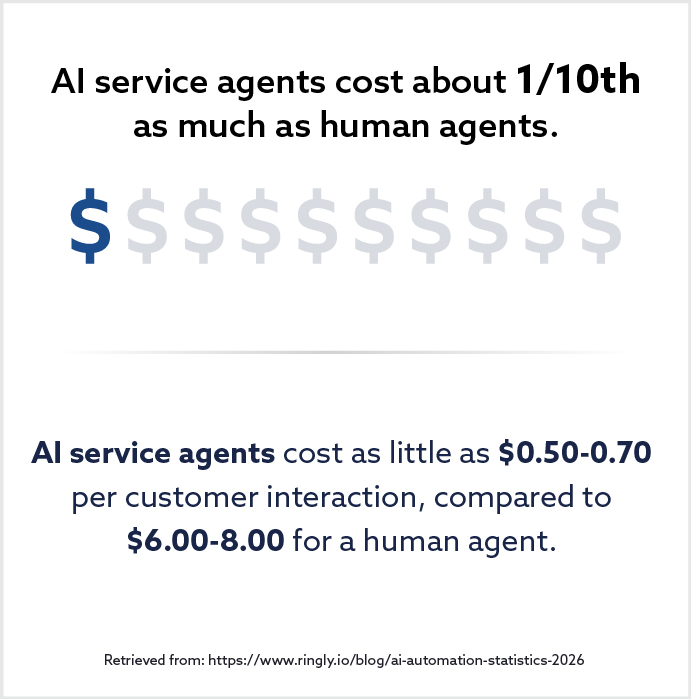
AI service agents cost as little as $0.50-0.70 per customer interaction, compared to $6.00-8.00 for a human agent.[6]
5. Employee Onboarding and Human Resources Workflows
Human Resources (HR) departments across all organization types rely heavily on onboarding processes that involve regulatory compliance and cross-department coordination. These workflows often span HR, IT, payroll, and management teams, each responsible for different steps in preparing a new employee for their role. In many organizations, onboarding is still managed through a combination of manual steps involving spreadsheets, physical paperwork, emails, and disconnected systems, which leads to inconsistent experiences and potential gaps in compliance. As hiring volume increases or organizations scale across locations, these inefficiencies become even more challenging to manage manually.
Questions to Ask
- What steps are required from offer acceptance to first-day readiness? How much time do they take (in worker hours)?
- Are the required documents consistently collected and verified?
- Are new hires consistently equipped with the knowledge and tools they need to get their questions about company policies, benefits, payroll and more answered?
How Sys.tm Helps
Sys.tm can be used to automate employee onboarding by triggering structured workflows that connect required departments into a single, coordinated process. From the moment an offer is accepted, the platform can begin a predefined sequence of tasks across HR, IT, payroll, and other stakeholders. Onboarding documentation can be collected in a variety of formats to create a digital personnel record for the new employee, and Sys.tm Intelligence can extract key identity information to populate databases and systems. By standardizing onboarding workflows across roles, departments, and locations, each new employee receives a structured, repeatable experience, while internal teams maintain visibility into progress at every stage. Over time, Sys.tm improves operational efficiency by reducing onboarding cycle times and minimizing compliance risk, ensuring that employees are fully equipped and ready to contribute from day one.
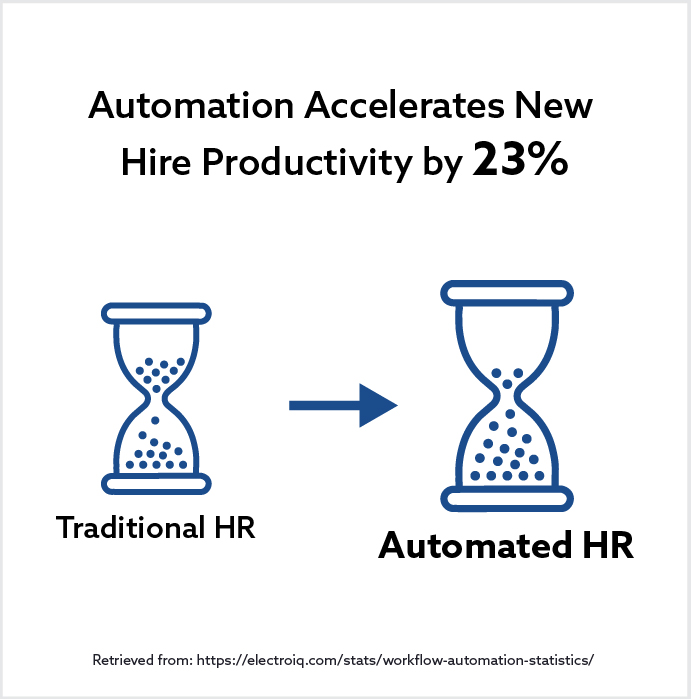
Automated HR on-boarding reduces time-to-productivity for new hires by an average of 23%.[7]
6. Reporting and Performance Analytics
Across the organization, reporting often forms the backbone of employee evaluations, compliance, and performance improvement. Every team collects data—such as sales pipelines, lead status, customer satisfaction, and on-time delivery—which is rolled into daily, monthly, and annual reports. These reports create a foundation for strategic decision-making for departmental and senior leadership. In many environments, reporting requires pulling data from multiple disconnected systems and manually compiling metrics before any analysis can begin. To produce monthly and annual reports, multiple shorter-term documents are compiled into spreadsheets or correlated manually. This process is not only time-consuming but also introduces inconsistencies and increases the likelihood of outdated or incomplete information being used for critical decisions. As business environments become more dynamic, delays in reporting directly impact an organization’s ability to respond effectively.
Questions to Ask
- Which metrics are most important to business performance and where are they tracked?
- How long does it take to generate reports, including daily, weekly, monthly, and annually?
How Sys.tm Helps
Sys.tm streamlines reporting and performance analytics by using AI to summarize and consolidate data from multiple systems into a unified report. Instead of relying on manual data aggregation, the platform organizes and standardizes information across departments and applications. Sys.tm Flows can automate report creation, triggered by date, threshold, or even certain information entering the system. The platform can also be used to automate report distribution to stakeholders without manual intervention, speeding informed decision-making.
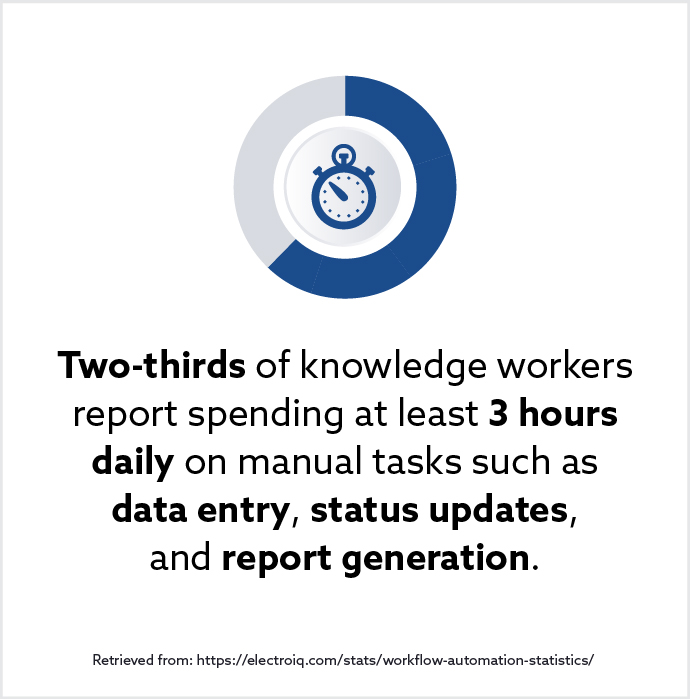
Two-thirds of knowledge workers report spending at least 3 hours daily on manual tasks such as data entry, status updates, and report generation.[8]
The Bigger Picture and Choosing What to Automate First
For most businesses, opportunities to automate are everywhere, and it may seem overwhelming. You’ll want to focus your efforts on the highest-impact, highest-reward projects such as the six identified in this article. Other ideal targets are high-volume, rules-driven workflows.
If you’re just getting comfortable with automation, we recommend starting with one or two core processes, so you can validate the return before scaling further.
Automation is no longer just about efficiency; it is about reducing manual work and improving operational visibility. It can even be a compelling and easy way to integration AI into core business processes in a way that offers real value. Platforms like Sys.tm support the shift to automation and AI, and Sys.tm’s composable foundation enables companies to build capabilities over time and keep budget focused on what the organization finds adds real value.
[1] https://www.forbes.com/councils/forbesbusinesscouncil/2025/07/23/the-hidden-costs-of-manual-processes-investing-in-automation/
[2] https://www.digitechsystems.com/gaining-competitive-advantage-with-composable-technology/
[3] https://cdn.digitechsystems.com/wp-content/uploads/IBPI-Case-Study.pdf
[4] https://www.shno.co/marketing-statistics/workflow-automation-statistics
[5] https://quixy.com/blog/workflow-automation-statistics-and-forecasts/
[6] https://www.ringly.io/blog/ai-automation-statistics-2026
[7] https://electroiq.com/stats/workflow-automation-statistics/
[8] https://electroiq.com/stats/workflow-automation-statistics/